
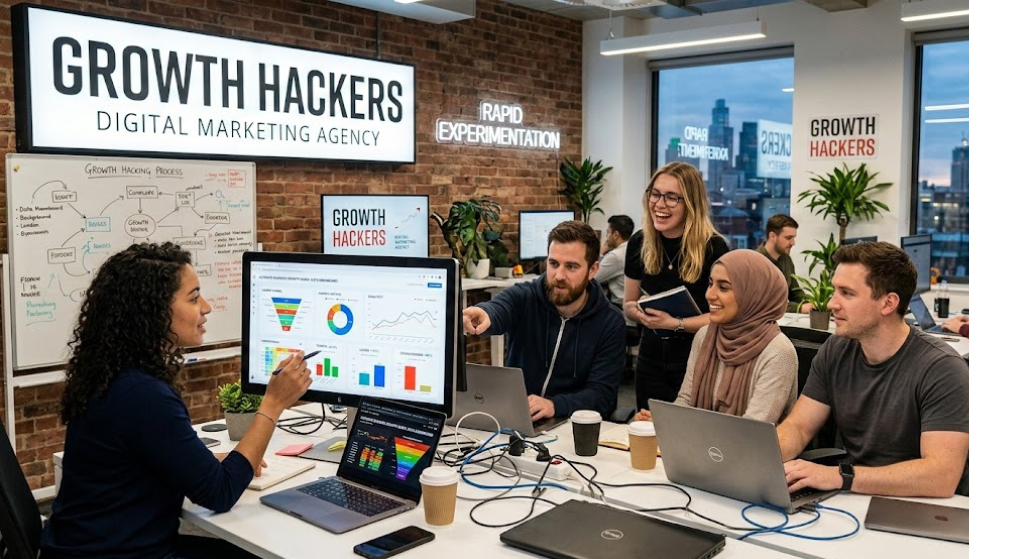
Engaging Introduction Idea
Why do some startups skyrocket while others burn through cash with nothing to show for it? It’s not always about having the best product. Often, it’s about having the smartest growth strategy.
Imagine two companies launching the same app. The first spends $20,000 on ads, runs them for three months, and hopes for the best. The second works with a growth hackers digital marketing agency. Instead of betting everything on one campaign, they test 15 different ad creatives, 5 landing page headlines, 3 pricing models, and 2 onboarding flows — all within 30 days. By the end of the month, they know exactly what converts, what doesn’t, and where to scale. That’s the difference.
Take Dropbox’s early referral system as a classic example. Rather than pouring money into advertising, they offered extra storage space to users who invited friends. Simple. Low cost. Highly effective. The result? Millions of users through word-of-mouth alone. That’s growth hacking in action — creative, data-driven experimentation focused purely on growth.
A growth hackers digital marketing agency operates with this mindset every day. Instead of asking, “How can we promote this brand?” they ask, “Where is the biggest growth opportunity right now?” Maybe your traffic is fine, but conversions are weak. Maybe customers buy once but never return. Instead of guessing, they test, measure, optimize, and repeat.
If you’re a business owner, here’s practical advice: start thinking in experiments, not campaigns. Don’t say, “Let’s run Facebook ads.” Say, “Let’s test five ad angles, track conversion rates, and scale the winner.” Shift from assumptions to data.
This introduction should make readers feel understood. Many businesses struggle not because they lack effort, but because they lack direction. By positioning growth hacking as the smarter, faster path to measurable results, you immediately hook the reader and promise something valuable: clarity in a crowded digital world.
What Is a Growth Hackers Digital Marketing Agency?
A growth hackers digital marketing agency isn’t just another marketing company running ads and posting on social media. Its main goal is simple: grow your business as fast and as efficiently as possible using data, testing, and smart experimentation.
Traditional agencies often focus on brand awareness — impressions, reach, and polished campaigns. Growth hackers focus on measurable outcomes — sign-ups, sales, retention, and revenue. Instead of asking, “How do we make this campaign look great?” they ask, “What small change will increase conversions by 10% this month?”
For example, imagine a SaaS startup struggling to convert free users into paid customers. A traditional agency might suggest a rebranding campaign. A growth hackers agency would dig into user behavior. They might test a shorter onboarding flow, add a limited-time upgrade offer, and run A/B tests on pricing pages. Within weeks, they identify which variation increases paid conversions and scale it.
Or take an eCommerce brand with high website traffic but low sales. Instead of spending more on ads, a growth-focused team might analyze checkout drop-offs, add trust badges, simplify forms, and introduce exit-intent discounts. A few small adjustments could recover 15–20% of abandoned carts. That’s growth thinking in action.
At its core, growth hacking is about experimentation. Agencies typically run multiple micro-tests every month — headlines, call-to-action buttons, email subject lines, ad creatives — and double down on what works. Nothing is based on guesswork. Everything is measured.
Here’s some practical advice: if your business is stuck — traffic is flat, sales aren’t scaling, or customers aren’t returning — you don’t just need “more marketing.” You need smarter testing. Start small. Test one landing page headline this week. Try one re-engagement email for inactive customers. Measure results.
A growth hackers digital marketing agency brings structure and speed to that process. They don’t promise magic. They build systems that turn data into growth.
Core Services Offered by Growth Hacker Agencies
Growth hacker agencies don’t just “do marketing.” They focus on services that directly impact growth — traffic, conversions, revenue, and retention. Every service they offer connects to measurable business results.
One of their core services is Conversion Rate Optimization (CRO). Instead of chasing more visitors, they improve how many visitors turn into customers. For example, an online store getting 50,000 monthly visitors but converting only 1% might not need more traffic. A growth team could test new product page layouts, clearer return policies, better product photos, or stronger call-to-action buttons. If conversion increases from 1% to 2%, revenue doubles without increasing ad spend. That’s smart scaling.
Another key service is performance marketing. This includes paid ads on platforms like Google, Facebook, or TikTok — but with heavy testing. Rather than running one ad for weeks, growth agencies test multiple creatives, headlines, and audience segments at once. A SaaS company might discover that short demo videos convert 3x better than static ads. Once they identify the winner, they scale aggressively.
They also focus on SEO with growth intent. Instead of writing random blog posts, they build content clusters around high-converting keywords. For instance, a CRM company might target keywords like “best CRM for small business” instead of generic terms like “what is CRM.” The goal isn’t just traffic — it’s qualified traffic that converts.
Email automation and retention strategies are equally important. Growth agencies design onboarding sequences, abandoned cart emails, upsell flows, and re-engagement campaigns. For example, an eCommerce brand might recover 18% of abandoned carts with a simple 3-step reminder email sequence.
Here’s practical advice: before spending more money on marketing, audit your funnel. Where are people dropping off? Landing page? Checkout? After first purchase? Fix leaks before adding more traffic.
In short, growth hacker agencies combine data, creativity, and rapid testing across multiple channels. Every service ties back to one question: “Will this move the revenue needle?”
How Growth Hackers Think Differently
Growth hackers don’t think in terms of campaigns. They think in terms of experiments.
That’s the biggest difference.
A traditional marketing team might spend weeks planning a big launch — polished creatives, a detailed content calendar, and a fixed budget. Once it’s live, they wait for results. Growth hackers take a different route. They launch fast, test multiple variations, study the data, and adjust quickly. Speed and learning matter more than perfection.
For example, imagine a new fitness app trying to increase sign-ups. A traditional approach might be: design one landing page, run ads, and hope it converts well. A growth hacker would create five versions of the landing page with different headlines — “Lose Weight Fast,” “Build Muscle in 30 Days,” “Personalized Workout Plans,” and so on. Within a week, they’d know which message resonates most. Then they scale the winner.
Another real-world example is onboarding optimization. Many SaaS companies lose users in the first 24 hours. Growth-focused teams analyze where users drop off. Is the signup form too long? Is the first dashboard confusing? Instead of guessing, they test shorter forms, guided tutorials, or progress bars. Even a 10% improvement in activation can dramatically increase long-term revenue.
Growth hackers also think about the full customer journey. They don’t stop at acquisition. If customers aren’t coming back, they’ll test re-engagement emails, loyalty rewards, or limited-time offers. Retention is often cheaper than new customer acquisition, and they know it.
Here’s practical advice you can apply right now: stop asking, “Will this work?” and start asking, “How can we test this quickly?” Run smaller tests before committing big budgets. Track one clear metric per experiment. Learn fast. Adjust faster.
At its core, growth thinking is about curiosity backed by data. It’s less about opinions in meetings and more about what the numbers say. That mindset alone can change how a business grows.
The Growth Hacking Framework Agencies Use
Growth hacker agencies don’t rely on random tactics. They usually follow a structured framework to find and fix growth bottlenecks. One of the most common models is the AARRR funnel — Acquisition, Activation, Retention, Revenue, and Referral. It sounds technical, but it’s actually very practical.
Let’s break it down in simple terms.
Acquisition is about getting people to discover you. This could be through SEO, paid ads, partnerships, or social media. For example, a new project management tool might run targeted LinkedIn ads aimed at startup founders. But growth agencies don’t just launch ads — they test different audiences, headlines, and offers to see what brings the most qualified traffic.
Next comes Activation. This is the moment when a visitor takes a meaningful first action — signing up, booking a demo, or adding a product to the cart. Imagine an eCommerce brand noticing that many visitors browse but don’t add items to their cart. A growth team might test clearer product descriptions, customer reviews, or limited-time discounts to encourage that first step.
Retention is where real growth happens. Getting customers once is good. Keeping them is better. A SaaS company, for instance, might discover users stop logging in after a week. The agency could introduce onboarding emails, feature tutorials, or usage reminders to keep them engaged.
Then comes Revenue. This involves optimizing pricing, upsells, and checkout processes. A small tweak — like offering an annual discount plan — can significantly increase average order value.
Finally, Referral focuses on turning happy customers into promoters. Think of how referral programs helped companies grow by rewarding users for inviting friends.
Here’s practical advice: identify where your biggest leak is. Are you struggling with traffic? Conversions? Repeat customers? Don’t try to fix everything at once. Focus on one stage of the funnel and run small experiments there.
Growth hacking works best when it’s structured. The framework keeps efforts focused, measurable, and scalable — instead of scattered and reactive.
Real-World Growth Hacking Case Studies
One of the best ways to understand growth hacking is through real-world examples. These case studies show how small, smart experiments can create huge results without massive budgets.
Take Dropbox, for example. When the company launched, they faced a classic startup challenge: getting users without spending heavily on advertising. Their solution? A referral program. Users who invited friends received extra storage, and the friends also got bonus storage. It was a low-cost, highly effective strategy that tapped into existing networks. The result? Millions of new users with minimal ad spend. This case highlights a core principle of growth hacking: leveraging your current audience to create exponential growth.
Another example comes from Airbnb. In their early days, they needed more visibility for their listings. Rather than relying solely on traditional marketing, they found a creative shortcut: Craigslist. They built a tool that allowed Airbnb hosts to automatically post their listings on Craigslist, tapping into an already massive user base. This clever experiment dramatically increased bookings and helped Airbnb gain traction in a competitive market.
Hotmail is another classic story. Instead of spending money on ads, they added a simple tagline at the bottom of every email sent: “PS: I love you. Get your free email at Hotmail.” This small, almost invisible tactic turned every user into a viral marketer, fueling rapid growth.
For eCommerce, an online fashion retailer might notice that many customers abandon carts. A growth-focused agency would test exit-intent popups offering discounts, limited-time offers, or reminders. Even small adjustments like changing button text or adding social proof can recover lost sales — often increasing revenue by 10–20% without extra traffic.
Here’s practical advice for business owners: start thinking like a growth hacker. Identify the bottleneck in your funnel — is it acquisition, activation, retention, or referral? Then, design small, testable experiments that directly target that issue. Measure results, double down on what works, and discard what doesn’t.
These case studies show that growth hacking isn’t about guesswork or flashy campaigns. It’s about creativity, data, and iterative testing, often achieving results that traditional strategies can’t match. Start small, experiment fast, and let the data guide your next move.
How to Choose the Right Growth Hackers Agency
Choosing the right growth hackers digital marketing agency can feel overwhelming. There are dozens of agencies claiming to “boost growth,” but not all of them operate with the data-driven, experiment-focused mindset that true growth hacking requires. Knowing what to look for can save time, money, and frustration.
Start by examining their track record. A strong growth hackers agency will have real case studies showing measurable results, not just fancy graphics or big promises. For example, one SaaS agency might show that they increased a client’s free-to-paid conversion rate by 25% within three months by testing onboarding flows and optimizing email sequences. This is different from an agency claiming “we can triple your traffic” without proof. Look for metrics that matter — conversions, revenue, retention — rather than vanity numbers like page views or social media likes.
Next, consider their approach to experimentation. Growth hacking isn’t about guesswork or one-off campaigns. The right agency runs multiple small experiments every month, learns from the results, and scales what works. Ask potential agencies how many experiments they run per month and how they measure success. A practical example: an eCommerce agency may test five different checkout layouts simultaneously, track which one reduces cart abandonment, and scale the winner. That’s the kind of evidence you want.
Transparency is key. The agency should provide clear reports, metrics, and insights so you can see what’s working and why. Avoid agencies that only share vague updates like “campaigns are performing well.” Instead, look for detailed dashboards or reports showing which tests are successful and which aren’t.
Finally, evaluate fit and communication. Growth hacking requires close collaboration. You want an agency that asks questions, understands your business goals, and can explain their methods in plain language. For instance, a startup founder may not have marketing expertise — a good agency will guide you, suggest experiments, and help prioritize actions.
Practical advice: start small. Consider a short-term project or trial period. Track the results and see if their methods align with your business priorities. Choosing the right growth hackers agency isn’t just about hiring experts; it’s about finding partners who can test, learn, and scale growth alongside your team.
A well-chosen agency doesn’t just run campaigns — they unlock opportunities you didn’t even know existed and help your business grow systematically and sustainably.
Cost of Hiring a Growth Hackers Digital Marketing Agency
Hiring a growth hackers digital marketing agency can feel like a big investment, but understanding how pricing works and what drives value helps you make smarter decisions. Unlike traditional agencies that might charge for ad spend or generic campaigns, growth hacker agencies focus on results, experiments, and measurable growth — and their pricing reflects that.
Typically, agencies offer three main pricing models. First, a monthly retainer, which can range from $1,500 for small startups to $20,000+ for larger businesses. This covers a set number of experiments, optimization work, and strategy planning. For example, a mid-sized eCommerce brand might pay $5,000 per month for an agency to run A/B tests on landing pages, optimize email flows, and manage paid ads. Over time, even a single successful experiment can more than pay for the monthly fee.
Second is performance-based pricing, where you pay based on results. Some agencies take a percentage of revenue generated from their campaigns or agree on a bonus for hitting growth targets. For instance, a SaaS company might agree to pay a 10% commission on new subscriptions that come directly from the agency’s experiments. This aligns incentives and reduces upfront risk, but it’s important to clearly define what counts as a “result.”
The third model is a hybrid approach, combining a smaller retainer with performance bonuses. Many businesses prefer this because it guarantees some dedicated work while keeping the agency motivated to deliver real results.
Here’s practical advice: don’t just compare agencies by their rates. Look at ROI potential. If an agency charges $5,000 per month but their experiments increase conversions by 20%, the investment is worthwhile. Conversely, a cheaper agency that doesn’t run structured experiments might waste money and time.
Another tip: start with a smaller project or trial period. For example, you could hire the agency for a 30-day experiment focusing on landing page optimization. Evaluate results, communication, and reporting before committing long-term.
Remember, growth hacking isn’t about flashy campaigns or vanity metrics — it’s about measurable impact. The cost may seem high initially, but a well-chosen agency will uncover growth opportunities and optimize your funnel in ways that can pay for themselves multiple times over. Thinking in terms of investment versus expense helps businesses make the smartest decision for sustainable growth.
DIY Growth Hacking Strategies You Can Apply Today
You don’t need a big agency or a massive budget to start growth hacking. Small, smart experiments can have a huge impact if you focus on the right areas. Here are some practical strategies you can implement today.
- Optimize Your Landing Pages
Your landing page is often the first impression a potential customer has. Small tweaks can boost conversions dramatically. Test different headlines, button colors, or calls-to-action. For example, an online course platform discovered that changing their signup button from “Submit” to “Start Learning Now” increased conversions by 15%. Don’t just guess — run A/B tests and measure which variation performs best. - Re-engagement Email Campaigns
Many businesses lose customers simply because they forget about them. Send targeted emails to inactive users. For instance, an eCommerce store might email customers who haven’t purchased in 30 days, offering a small discount or showing trending products. Even a single well-timed email can recover 10–20% of inactive customers. The key is personalization — address the customer by name and reference past interactions. - Referral Programs
Turning existing customers into advocates is one of the fastest ways to grow. Dropbox’s early growth relied entirely on referrals — giving extra storage to users who invited friends. You don’t need to copy them exactly, but consider incentives that motivate your customers to share your product. Even small rewards, like discounts or freebies, can create viral loops. - Content Repurposing
One piece of content can reach multiple audiences if you repurpose it. Turn a blog post into a series of LinkedIn posts, a short video for social media, or a carousel for Instagram. A SaaS company, for example, turned a single tutorial blog into five different social media posts and a webinar, increasing traffic and signups without creating new content from scratch.
Practical Advice:
Start small. Pick one experiment at a time and measure results. Don’t try to do everything at once. Track one clear metric per experiment — signups, conversions, or engagement — and scale what works. Treat every change as a test, not a permanent decision.
DIY growth hacking is all about curiosity, testing, and iteration. By focusing on small, measurable changes, you can boost results without blowing your budget — and you’ll also develop a mindset that’s ready for bigger, more sophisticated experiments down the line.
Benefits of Hiring a Growth Hackers Agency
Hiring a growth hackers digital marketing agency can transform the way your business approaches marketing. Unlike traditional agencies, these teams focus on measurable growth, rapid experimentation, and data-driven decisions. The benefits go beyond just more traffic or social media likes — they help your business grow systematically and sustainably.
One of the biggest advantages is faster experimentation. Growth hackers run multiple small tests every month, from landing page variations to email sequences or ad creatives. For example, a SaaS startup struggling with free-to-paid conversions hired a growth agency that tested three different onboarding flows simultaneously. Within weeks, they identified the version that increased paid sign-ups by 25%. The speed of testing means you don’t waste months guessing what works — you learn quickly and scale fast.
Another benefit is data-backed decisions. Growth agencies don’t rely on opinions or “gut feelings.” Every strategy is tracked and measured. Consider an eCommerce brand with a high cart abandonment rate. A growth-focused team analyzed user behavior, tested exit-intent popups, and introduced limited-time discounts. The results? A 15% recovery of abandoned carts — without spending a penny on extra traffic. That’s the power of measurable, actionable insights.
Higher ROI is another reason businesses hire growth hackers. Instead of throwing money at advertising or broad campaigns, they optimize funnels, retention strategies, and referral programs. Even small improvements in conversion or retention can significantly boost revenue. For example, a subscription box company increased monthly revenue by 20% after implementing a series of email triggers and referral incentives suggested by their growth agency.
Finally, hiring a growth agency gives you a scalable marketing system. You’re not just getting a one-time campaign — you’re building processes, experiments, and optimization strategies that continue to drive results long-term. They also provide a competitive advantage by uncovering growth opportunities you might never see on your own.
Practical advice: Focus on agencies that clearly outline experiments, metrics, and results, rather than those selling generic campaigns. Start small with a trial project, measure outcomes, and scale what works.
In short, a growth hackers agency doesn’t just market your business — it builds a growth engine that keeps improving, helping you achieve faster, smarter, and more sustainable results.
Common Mistakes Businesses Make Without a Growth Strategy
Many businesses struggle not because their products are bad, but because they lack a structured growth strategy. Without a clear plan, efforts are scattered, budgets are wasted, and opportunities slip through the cracks. Recognizing these mistakes is the first step toward smarter, more sustainable growth.
One of the most common errors is focusing solely on traffic without optimizing conversions. For example, an online clothing store might invest heavily in Facebook ads to bring in visitors, but if their checkout process is confusing or slow, most visitors leave without buying. The result? High traffic, low sales. Practical advice: always audit your funnel before scaling traffic. Optimize landing pages, forms, and calls-to-action first — small improvements can deliver big results.
Another frequent mistake is neglecting retention. Many businesses obsess over acquiring new customers while ignoring the ones they already have. A SaaS startup, for instance, might spend thousands attracting new sign-ups but lose 40% of users within the first month due to poor onboarding or lack of engagement. Growth hackers know that keeping existing customers is often cheaper and more profitable than acquiring new ones. Start by implementing welcome emails, tutorials, or re-engagement campaigns to reduce churn.
Relying on guesswork instead of data is also a critical misstep. Some companies launch campaigns based on assumptions — “This headline will work” or “People will love this discount” — without testing or tracking results. For example, a local gym ran a promotion they assumed would attract members but saw almost no response because they didn’t test the offer or measure engagement. Practical advice: track one clear metric per experiment, run small A/B tests, and scale what actually works.
Finally, ignoring referral and word-of-mouth opportunities can stunt growth. Many businesses underestimate how powerful customer advocacy can be. Dropbox’s early success, for example, came from incentivizing referrals rather than spending on ads. Implementing even a simple referral program can dramatically increase new users or clients.
In short, businesses without a growth strategy often waste resources on the wrong metrics, overlook retention, and make decisions based on assumptions. The solution is clear: adopt a structured approach, focus on measurable experiments, and continuously optimize every stage of the customer journey. With a smart growth strategy, every effort counts toward meaningful results.
Future of Growth Hackers Digital Marketing Agencies
The world of digital marketing is evolving rapidly, and growth hackers agencies are at the forefront of that change. As technology advances, these agencies are becoming more data-driven, automated, and predictive, helping businesses grow faster and smarter than ever before.
One major trend is AI-driven personalization. Modern tools can analyze user behavior in real time and deliver highly personalized experiences. For example, Netflix doesn’t just recommend content randomly — it uses AI to suggest shows based on viewing habits, time of day, and even user mood patterns. Growth hackers agencies are beginning to use similar strategies for businesses, tailoring emails, landing pages, and ad creatives for individual users to maximize engagement and conversions.
Another shift is predictive analytics. Instead of reacting to past data, agencies can now forecast user behavior and revenue trends. For instance, an eCommerce brand might use predictive analytics to identify customers most likely to abandon their carts, and then trigger automated incentives to retain them. This proactive approach transforms marketing from guesswork into precise decision-making.
Automation and no-code experimentation tools are also changing the game. Agencies can quickly set up tests, run multiple campaigns, and monitor results without complex coding. For startups and small businesses, this means faster iteration at lower costs. A practical example: a SaaS company could deploy five different onboarding flows simultaneously using a no-code platform, gather insights in days, and scale the most effective version — all without relying heavily on IT resources.
Practical advice for businesses: start integrating technology into your growth strategy now. Even small steps, like using email automation, AI-based ad targeting, or predictive segmentation, can provide a competitive edge. Don’t wait until your competitors outpace you with smarter tools.
Finally, the human element remains critical. The agencies that succeed in the future will combine technology with creative thinking, experimentation, and a deep understanding of customer psychology. Growth hacking isn’t just about tools; it’s about mindset — being curious, iterative, and relentlessly focused on measurable growth.
In short, the future of growth hackers digital marketing agencies is smarter, faster, and more precise. Businesses that partner with these forward-thinking teams will not only keep up with the market but can anticipate trends, optimize strategies in real time, and drive growth in ways that were unimaginable just a few years ago.
