
Many guitarists face a highly frustrating bottleneck in their musical journey. Your left hand is fast, agile, and completely capable of flying across the fretboard to play your favorite complex solos. Yet, your right hand simply cannot keep up. It feels like a heavy anchor holding back your true musical potential. For many players, spending two whole years of focused practice results in zero progress toward streamlining their technique. Instead of developing a smooth, automated motion, they find themselves stuck using completely different picking approaches for every separate playing situation. This fragmented approach is highly detrimental to overall fluidity, speed, and clean execution.
When you constantly switch your mechanics depending on the phrase you are playing, your muscle memory becomes deeply confused. For example, a guitarist might naturally fan their fingers out and apply heavy physical pressure onto the bridge just to make their palm mutes sound deep and chunky. While this action achieves a great heavy metal tone, the immense downward pressure makes it virtually impossible to cross strings cleanly or transition into a fast solo. When switching to rapid single-note lines, they might alter their hand posture entirely, closing their wrist and pulling their fingers inward to find an upward escape motion. This constant shifting between disparate hand shapes creates a mechanical nightmare that stalls any real, measurable progress.
Analyzing String Resistance and Pick Biomechanics
Another common issue stems from a lack of physical feedback from the strings themselves. When a musician cannot properly feel the string for a physical reference point, they tend to overcompensate. They dig the pick far too deeply into the instrument’s string plane. This causes a severe hooking effect on the upstroke, where the plectrum literally gets caught on the way back up. To counter this frustrating physical resistance, players often experiment with an endless array of different pick shapes, thicknesses, and exotic materials, such as ultra-sharp tips or specialized boutique jazz picks.
However, hardware changes alone rarely solve a fundamental mechanical issue. While a sharper plectrum tip might glide smoothly over thin steel strings, it often increases friction and resistance on the heavy, wound strings. This added resistance makes heavy palm muting feel incredibly stiff, awkward, and difficult to control. Trying to unlearn old habits by applying a closed-wrist single-note technique to your palm mutes often causes a complete loss of the hand’s natural anchor point. To regain momentum against the heavy string resistance, players often close their wrist even tighter, forcing their hand lower until their knuckles begin to scrape against the guitar body.
How Innovative Software Features Can Transform Your Technique
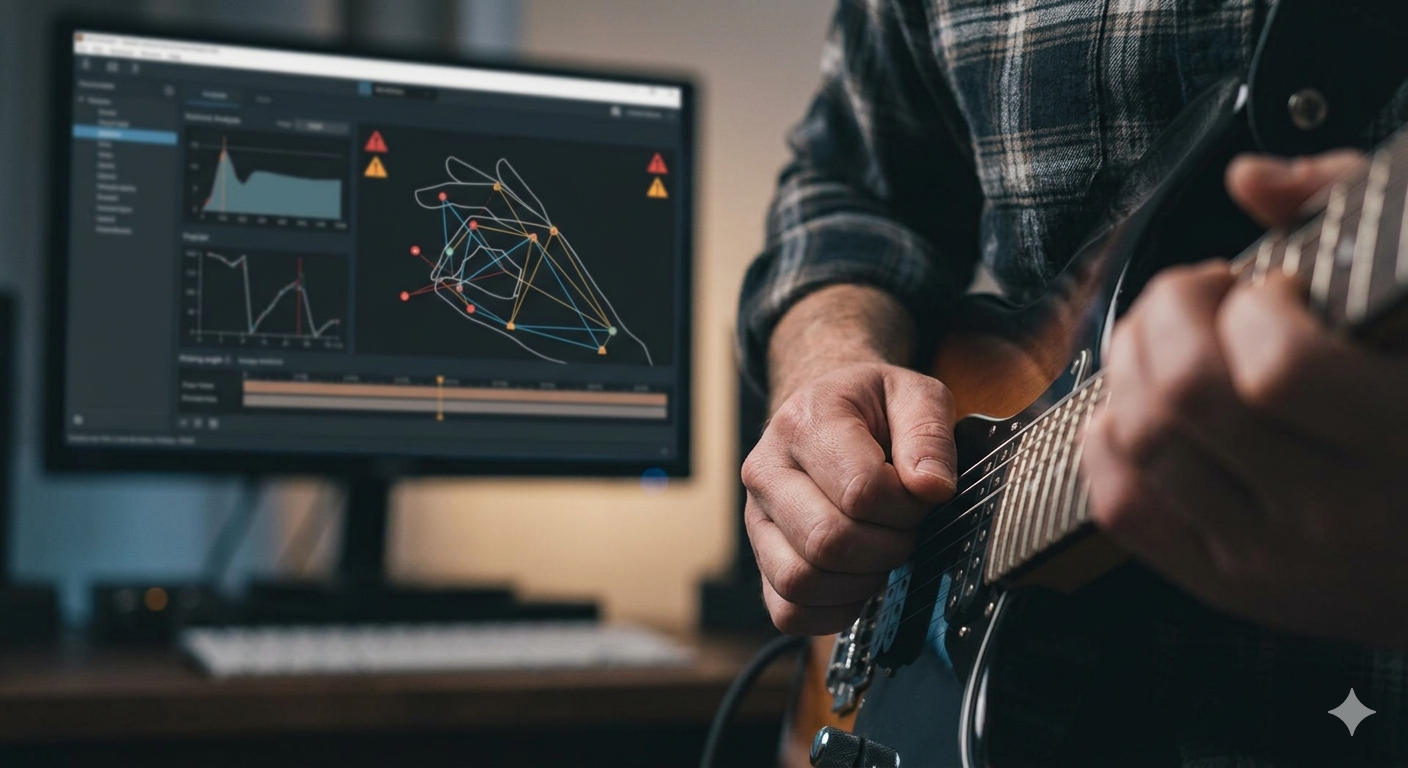
Thankfully, modern digital technology offers brilliant solutions to these physical roadblocks. By utilizing cutting-edge guitar training applications, players no longer have to guess what is going wrong with their hand angles. Advanced software features leverage the power of artificial intelligence and standard computer webcams to analyze a guitarist’s hand positioning in real time. These smart tools map out the precise trajectory of your upward and downward escape motions, providing visual feedback that human eyes often miss entirely during a fast practice session.
If you want to explore the latest digital platforms offering these analytical tools, you can discover incredible resources at xfollow.co.uk. These platforms help bridge the gap between frustrating physical limitations and digital clarity. By converting your physical hand movements into visual data points, the right software features show you exactly when your wrist angle collapses or when your pick digs too deep into the wound strings. This allows you to make microscopic adjustments to your technique based on objective data rather than vague intuition.
Key Takeaways
Fragmented picking techniques, such as changing your hand shape completely between palm mutes and single notes, ruin your muscle memory and slow down your overall progress.
Sharper picks can reduce friction on thin strings but often increase resistance on wound strings, proving that mechanical adjustments are better than hardware changes.
Modern AI software features provide real-time biomechanical feedback to fix wrist angles and escape motions without losing your physical anchor points.
Overcoming the Knuckle-Dragging Dilemma
When guitarists attempt to adjust their wrist angle manually to avoid scraping the strings, they often inadvertently alter their entire escape path. Fixing one minor issue accidentally destroys their upward escape motion, leaving them trapped in a continuous loop of mechanical failures. You might feel like you are knuckle dragging my life away when every single practice session feels like a painful battle against your own anatomy rather than a fun, rewarding musical experience.
To break out of this exhausting cycle, digital software features offer specialized slow-motion playback and posture overlay metrics. These features function like a digital mirror, showing you the exact millimeter of clearance needed to maintain an ideal escape velocity without sacrificing your anchor point. Achieving this level of mechanical perfection requires patience and a structured overview. If you need a fun mental break from intense technical practice, checking out classic entertainment lists like the top Arnold Swansinger movies can clear your mind before diving back into deep analysis. Just like an action star relies on precise choreography, a guitarist relies on precise mechanical software data to execute flawless movements.
The Power of Data-Driven Guitar Practice
Relying entirely on physical feel can be incredibly deceptive because what feels right in the moment might actually be a bad habit forming. Software features that include speed-tracking graphs and tension-detection algorithms give musicians objective metrics to study. Instead of guessing why your upstroke is catching on the wound strings, the software pinpoints the exact angle of attack that is causing the physical hitch.
Using high-authority educational guides, such as the comprehensive technique breakdowns found on Guitar World or historical overviews of mechanical developments on Wikipedia, alongside your interactive software can rapidly accelerate your growth. Combining expert theory with real-time software diagnostics ensures that your right hand finally catches up to the speed and accuracy of your left hand. You will no longer waste hours practicing inefficient movements that actively harm your long-term playing goals.
Streamlining Your Practice Routine with Automation
Ultimately, the goal of integrating smart software features into your daily routine is to automate good habits. When the software alerts you the exact moment your fingers begin to fan out inappropriately during a palm mute, you can make instant corrections before that bad habit solidifies into your permanent muscle memory. This direct feedback loop saves you months, if not years, of painful unlearning. Stop fighting your instrument in isolation and let data-driven insights guide your hands toward effortless, fluid speed.
Overcoming complex guitar picking issues requires moving away from frustrating guesswork. By leveraging modern software features, you can analyze your hand mechanics, eliminate string resistance, and fix your wrist angles with absolute precision. Stop letting an inefficient right hand hold back your musical progress. Instead, use live feedback to practice smarter, allowing your technique to quickly transform into a smooth, effortless tool for your ultimate personal and creative musical expression.
Frequently Asked Questions
How can software features help improve my guitar picking?
Software features use AI video tracking and motion analysis to break down your picking hand’s angles, paths, and escape motions, highlighting mechanical flaws that are impossible to spot with the naked eye.
Why does a sharper pick cause more resistance on wound strings?
Sharper tips can dig deeply into the physical grooves of wound strings, drastically increasing friction. This makes smooth palm muting more difficult compared to using a pick with a slightly rounded edge.
What is an upward escape motion in guitar picking?
An upward escape motion is a picking technique where the pick travels at an inherent angle so that it clears the strings completely on the upstroke, preventing it from getting hooked or trapped between adjacent strings.
How do I fix my knuckles dragging on the guitar strings?
Knuckles usually drag when a player closes their wrist too much to force artificial momentum. You can fix this by using software to analyze your exact wrist angle and adjusting your posture to maintain proper string clearance.
Can software features help me synchronize my left and right hands?
Yes, many modern practice apps include synchronization metrics and audio-visual alignment features that track both hands simultaneously, ensuring your picking speed matches your fretting capability perfectly.